
Best Teaching Strategies for SEND Maths Learners

Students with Special Educational Needs and Disabilities (SEND) often bring unique strengths to mathematics, including logical thinking, pattern recognition and attention to detail. However, traditional approaches to teaching maths do not always align with how these students learn best.
In my experience as an online maths tutor, the biggest barriers are rarely ability or motivation. More often, students struggle because maths is taught in ways that overload working memory, move too quickly between concepts, or rely heavily on abstract thinking.
Over the years, I have worked with students with dyslexia, ADHD, autism and processing difficulties, and while every learner is different, the most successful approaches tend to share the same principles: breaking learning into smaller steps, using repetition consistently, and making mathematics as visual and concrete as possible.
Why Students with SEND Often Struggle with Maths – SEND Maths
SEND Maths Guide
Mathematics requires students to hold multiple pieces of information in their minds at once while applying procedures and solving problems. For students with SEND, this can quickly become overwhelming.
Common difficulties include:
• Remembering multi step methods
• Understanding mathematical vocabulary
• Transferring knowledge between topics
• Processing large amounts of information at once
• Maintaining confidence after repeated mistakes
The solution is rarely lowering expectations. Instead, effective teaching removes unnecessary barriers so students can access the mathematics itself. Before teaching begins, an initial assessment or short quiz is always worth doing with a new student. It helps identify where the gaps are, what they do not understand and possibly why, and which techniques are most likely to be useful. This is far more effective than starting with assumptions.
1. Break Maths into Smaller Steps
Many students with SEND find multi step questions overwhelming.
One of the most effective strategies I use in lessons is chunking, where complex methods are broken into smaller, manageable stages. Instead of teaching an entire process at once, students focus on mastering one step before moving to the next.
For example, when solving equations, students first learn how to isolate terms before progressing to more complicated algebraic manipulation.
This approach reduces cognitive overload and helps students experience success more regularly.

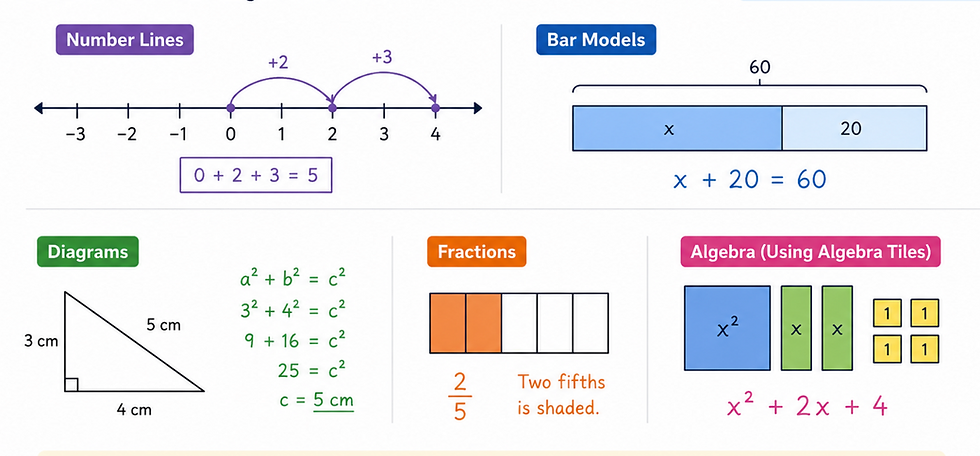
2. Use Visual and Concrete Representations
Mathematics is highly abstract, but many students understand concepts far more easily when they can see or manipulate them.
In my own teaching, I regularly use:
• number lines
• bar models
• diagrams
• colour coding
For many learners, visual understanding develops before procedural fluency.
3. Teach Mathematical Vocabulary Explicitly
Mathematics has its own language, and vocabulary often becomes an invisible barrier.
Words such as factor, simplify, estimate and evaluate may seem obvious to teachers but can cause significant confusion for students.
I have taught students who understood the mathematics perfectly once the terminology was explained clearly.
Pre teaching vocabulary allows students to focus on solving problems rather than decoding language.
4. Use Repetition and Retrieval Practice
Many students with SEND benefit from more repetition than their peers, and there is absolutely nothing wrong with that.
Short quizzes, regular review and revisiting previous topics are often more effective than teaching a topic once and moving on.
Some of my students have needed to revisit fractions or algebra several times before everything clicked, but once it did, their progress accelerated rapidly.
Learning is rarely linear.

5. Keep Lessons Structured and Predictable
Consistency reduces anxiety and cognitive load.
In my lessons, I try to maintain a similar structure each week:
• review previous learning
• introduce new material
• practise together
• move towards independent questions
• finish with reflection and review
Many students perform better when they know exactly what to expect from a lesson.
6. Reduce Cognitive Load
Too much information at once can prevent learning from happening at all.
Simple adjustments can make a huge difference:
• giving one instruction at a time
• avoiding cluttered worksheets
• reducing unnecessary text
• modelling examples clearly
• checking understanding frequently
Reducing cognitive load is not lowering standards. It is improving accessibility.

7. Build Confidence Through Success
Perhaps the biggest challenge I encounter as a tutor is confidence.
Many students with SEND arrive convinced that they are "bad at maths" because previous experiences have damaged their self belief.
Creating opportunities for success, celebrating progress and treating mistakes as part of learning often has just as much impact as the mathematics itself.
One of the most rewarding parts of tutoring is seeing students who once said, "I'm just not a maths person," gradually begin solving problems independently and developing confidence in their own abilities.
8. Use Assistive Technology Where Appropriate
Technology can remove significant barriers when used effectively.
Examples include:
• text to speech tools for worded problems
• digital whiteboards
• interactive graphing software
• speech to text tools for written explanations
The goal is not to make maths easier, but to remove barriers that prevent students from demonstrating what they understand.

9. Remember That SEND Is Not One Category
Different students require different approaches.
Students with dyslexia may benefit from visual methods and reduced text.
Students with ADHD often respond well to shorter activities, movement breaks and frequent feedback.
Students with autism frequently benefit from predictable lesson structures and explicit instructions.
Students with speech and language needs often benefit from pre teaching vocabulary and discussing ideas verbally before writing them down.
Understanding the individual student is always more important than applying a generic strategy.
10. Gradual Exam Preparation
Exam papers can feel overwhelming for students with SEND.
Breaking exam preparation into small steps can make a significant difference.
This might involve:
• practising one question type at a time
• gradually introducing timed conditions
• explicitly teaching command words
• building familiarity with exam layouts and mark schemes
Confidence with the format often improves performance as much as content knowledge itself.
Final Thoughts
Students with SEND are not struggling because they lack ability or motivation.
More often, the learning environment simply has not been adapted to meet their needs.
With patience, consistency and the right teaching strategies, I have seen students who once avoided maths lessons go on to achieve results they never believed were possible.
The goal of SEND maths teaching is not to make mathematics easier.
It is to make mathematics accessible.
Every student learns differently, but every student is capable of making progress when teaching adapts to meet their needs.
If you are considering one-to-one maths tuition for a child with SEND, it is important to choose a tutor with experience supporting learning differences such as ADHD, dyslexia, dyscalculia, autism and processing difficulties. The right tutor will not simply reteach content, but adapt their approach to suit the way your child learns best.
If you would like to explore how tailored one-to-one support could help your child build confidence and achieve their potential in maths, I offer a free introductory consultation to discuss their needs, goals and how I may be able to support them.



Comments