
Year 8 Maths Linear Inequalities Step by Step

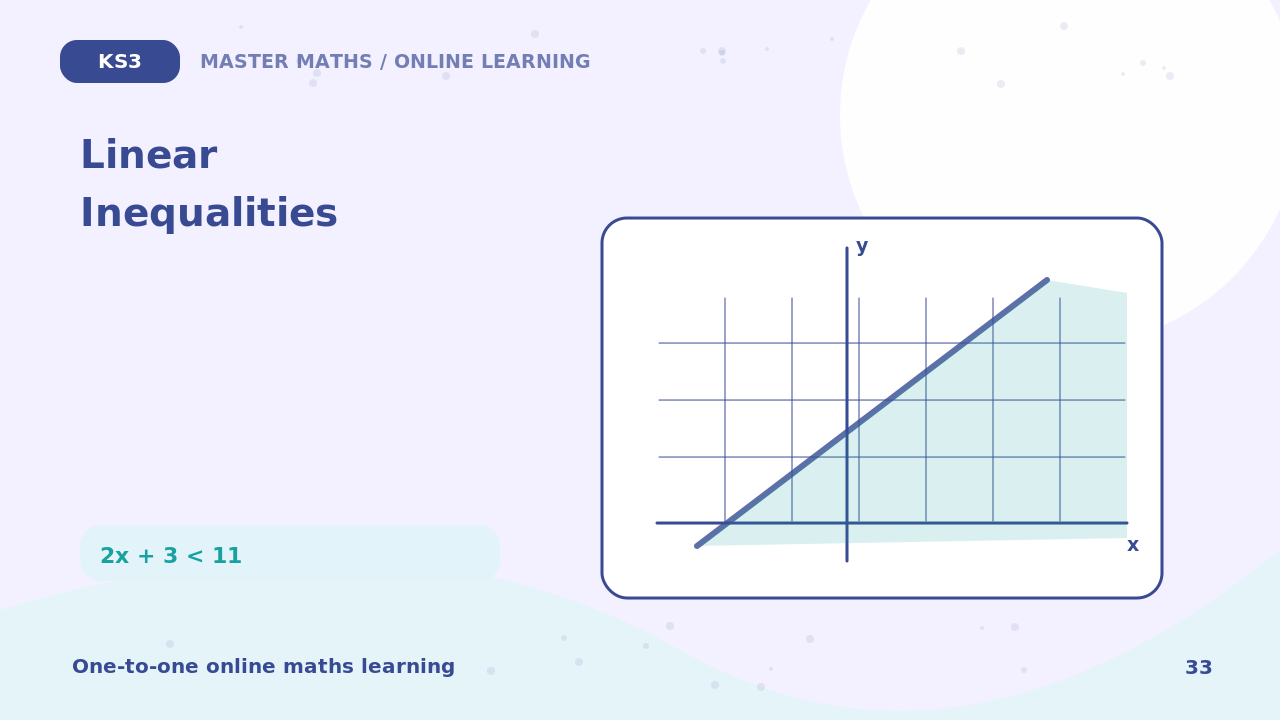
A linear inequality resembles an equation, but its answer is usually a range rather than a single number. The signs <, >, ≤ and ≥ describe which values are allowed. Year 8 students can use their familiar equation-solving methods as long as they remember the key difference: multiplying or dividing by a negative number reverses the inequality direction.
Understand the four symbols
The sign > means greater than, and < means less than. The symbols ≥ and ≤ also include equality. Thus x > 4 includes values larger than four but not four itself, whereas x ≥ 4 does include four. On a number line, use an open circle when the endpoint is excluded and a filled circle when included. Match the boundary mark with the mathematical sign before drawing the shaded interval.
Related reading: How to Solve Two-Step Equations at KS3
Solve a one-step inequality
For x + 5 < 12, subtract five from both sides to obtain x < 7. Check a valid example: x = 6 gives 11 < 12. At x = 7 the original statement becomes 12 < 12, which is false. The answer is therefore an entire range, not x = 7. This substitution check helps pupils understand why the chosen boundary is included or excluded.
Related reading: GCSE Maths Completing the Square Step by Step
Solve a two-step inequality
Start with 3x − 4 ≥ 11. Add four to both sides, giving 3x ≥ 15, then divide by positive three to obtain x ≥ 5. Test x = 5, which gives 11 and satisfies the inequality. Test x = 4, which gives 8 and fails. Emphasise that addition, subtraction and division by positive quantities preserve the inequality direction.
Related reading: A-Level Statistics: Normal Distribution Explained Step by Step
Reverse the sign with negative coefficients
For −2x > 6, divide by −2 and reverse the sign: x < −3. Check x = −4: the original becomes 8 > 6, which is true. But x = 0 gives 0 > 6, which is false. Multiplying by a negative reverses order on the number line. This reasoning is more reliable than treating the sign change as a detached slogan to memorise.
Represent compound intervals
The statement 2 ≤ x < 6 describes values from two inclusive to six exclusive. Draw a filled circle at two, an open circle at six and shade the segment between them. Do not shade both outward directions. A compound inequality combines two conditions that must hold at once. Try a permitted value such as 4 and a forbidden value such as 7 to confirm the diagram.
Related reading: GCSE Maths Simultaneous Equations Explained Step by Step
Develop independent checking habits
Start with simple inequalities, then add negative coefficients, brackets and number-line diagrams. Ask for two examples that satisfy the answer and one that does not. When a student cannot solve the inequality, check whether balancing and inverse operations are already secure for equations. These skills will later support graphical inequalities and mathematical modelling.
Related reading: Year 8 Maths Sequences and Nth Terms
Frequently asked questions
Does dividing always reverse the inequality?
Only dividing or multiplying by a negative number reverses its direction.
Can an inequality answer include decimals?
Yes, unless the question restricts the answer to integers or another specified set.
Explore further KS3 resources
The related resources below address supporting skills. Choose those that match the specific questions you find difficult rather than reading every article in one sitting.
Book a free maths introduction
If a topic remains difficult after independent practice and school feedback, discuss whether one-to-one online lessons would be appropriate. MasterMaths offers a free 20-minute introduction with Ryan to clarify needs and practical arrangements. Learning progress varies, and no specific grade increase is guaranteed.
Get started: Book a free maths introduction session


Comments