
From Procedural Learner to Rational Thinker: The Philosophy Behind My Teaching

Updated: Jul 17
When I teach mathematics, my aim is not simply for students to get answers correct.
My goal is to develop rational thinkers.
This philosophy is deeply personal and stems from my own experience learning mathematics.
As a GCSE student, I became highly proficient at what I would now describe as procedural mathematics. I could recognise question types, recall methods and apply algorithms efficiently. If a question resembled one I had seen before, I was usually successful.
However, success often depended on familiarity.
When questions became less structured or required deeper reasoning, the methods I had memorised were no longer enough.
Looking back, I realised that I had become very good at performing mathematics without necessarily thinking mathematically.
Like many students, I had unconsciously adopted the belief that mathematics was primarily about remembering procedures.
It was not until A Level that my relationship with mathematics changed.
For the first time, mathematics demanded more than execution.
It asked for explanation.
It asked for justification.
It asked for proof.
It asked whether a result would always be true and under what conditions it might fail.
Rather than asking what is the answer?, mathematics started asking:
Why does this work?
Can you convince somebody else?
What assumptions are being made?
Can this idea be generalised?
What happens if we change the conditions?
This was the point at which I stopped seeing mathematics as a collection of methods and started seeing it as a discipline built upon reasoning.
I had begun the transition from procedural learner to what I now describe as a rational thinker.
That experience fundamentally shaped my teaching practice.
Since then, much of my academic work and professional development has revolved around a single question:
How can we help students become rational thinkers, and what does that process actually involve?
This question has influenced not only my research interests but also the structure of my lessons, the tasks I design and the types of conversations I encourage within my tutoring sessions.

A hierarchy of mathematical thinking – Procedural Learner
In my teaching practice, I view mathematical understanding as developing through several stages and alot of my mathematical reaserch stems around these 5 core ideas.
1. Core Skills – Procedural Learner
Reasoning cannot develop without fluency.
Students should have a strong understanding of the steps involved and feel confident using basic techniques. Fluency reduces cognitive load and creates the capacity for higher-order thinking. However, fluency is not the endpoint. It is the foundation.
2. Clarify
Once students can perform procedures, I want them to make sense of them.
This involves interpreting ideas, explaining concepts in their own words and confronting misconceptions.
Students move from asking:
"What do I do?"
to asking:
"What does this actually mean?"
3. Justify
This stage represents an important shift in mathematical identity.
Students begin explaining why methods work rather than simply demonstrating that they work.
Reasoning becomes explicit.
Arguments become important.
Mathematics becomes something that can be defended rather than merely performed.
4. Challenge
At this stage, students encounter unfamiliar situations where memorised procedures are insufficient.
They must adapt previous knowledge, test conjectures and evaluate possible approaches.
This is often where genuine mathematical confidence begins to emerge.
Students realise they can think their way through problems rather than search for a remembered example.
5. Generalise
For me, this represents the highest level of mathematical thinking.
Students identify structure, recognise patterns and formulate general rules.
They move beyond individual examples towards universal mathematical truths.
Rather than asking:
"What happens here?"
they begin asking:
"Will this always happen?"
This is the type of thinking that characterises mathematicians.
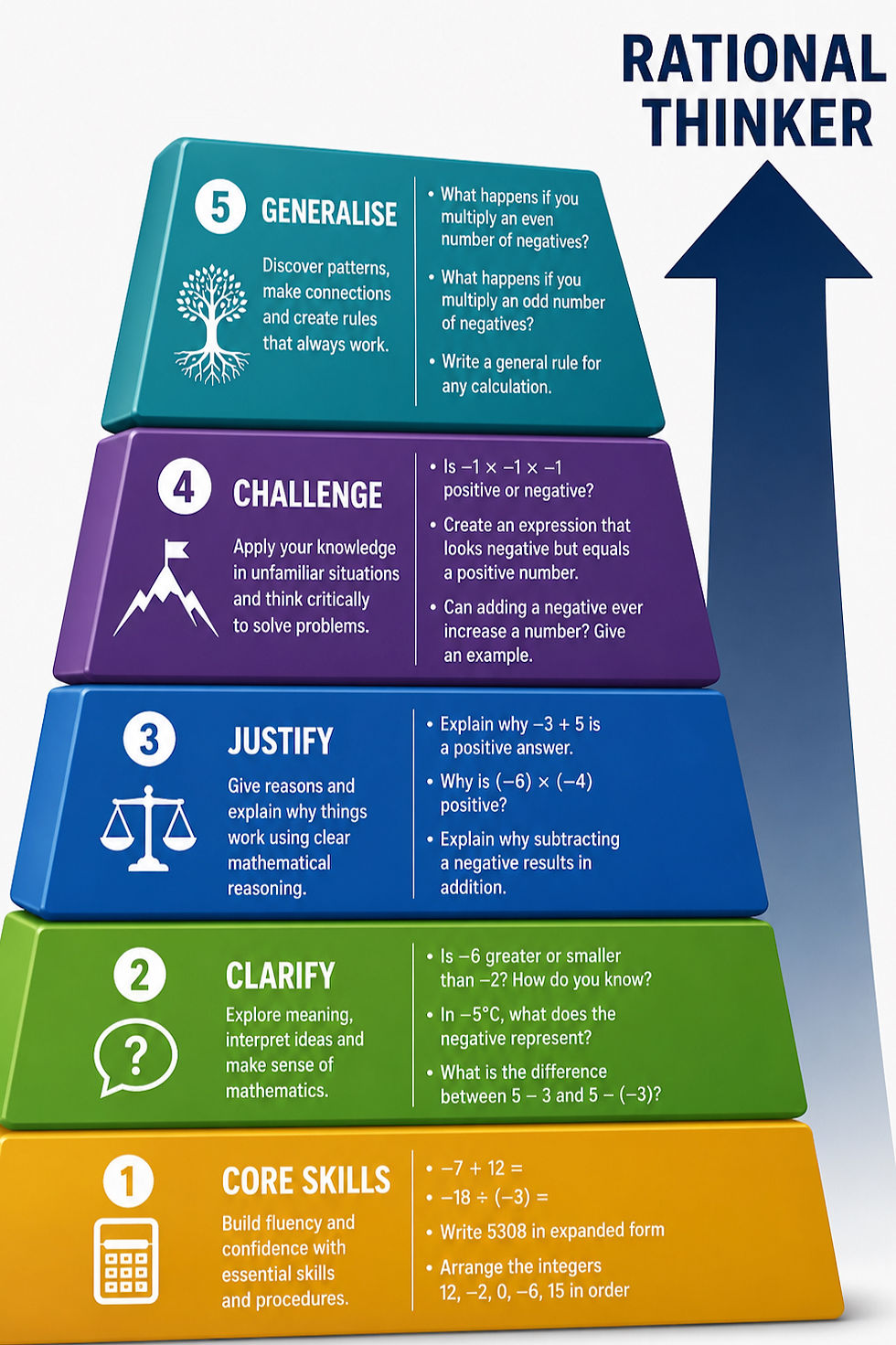
The Rational Thinker
The purpose of this progression is not simply examination success, although it undoubtedly supports performance in GCSE and A Level mathematics.
The broader aim is the development of students who:
seek explanations rather than accept rules,
question assumptions,
communicate their reasoning clearly,
recognise patterns and structure,
evaluate arguments critically,
and approach unfamiliar situations with confidence.
These are not merely mathematical attributes.
They are characteristics of rational thinkers.
Ultimately, this is what I want my students to become.
Not students who can reproduce mathematics.
But students who can think mathematically.
Because mathematics is not simply a body of knowledge to be remembered.
It is a way of thinking about the world.
And if education can cultivate that way of thinking, its impact extends far beyond the mathematics classroom.
Book a free intro call
Whether you're studying KS3, GCSE, IGCSE or A Level Mathematics, my aim is not simply to improve grades but to develop confident students who understand, reason and think mathematically.
If that sounds like the kind of support you're looking for, feel free to book a free one-to-one introductory session and see whether we're the right fit.


Comments